
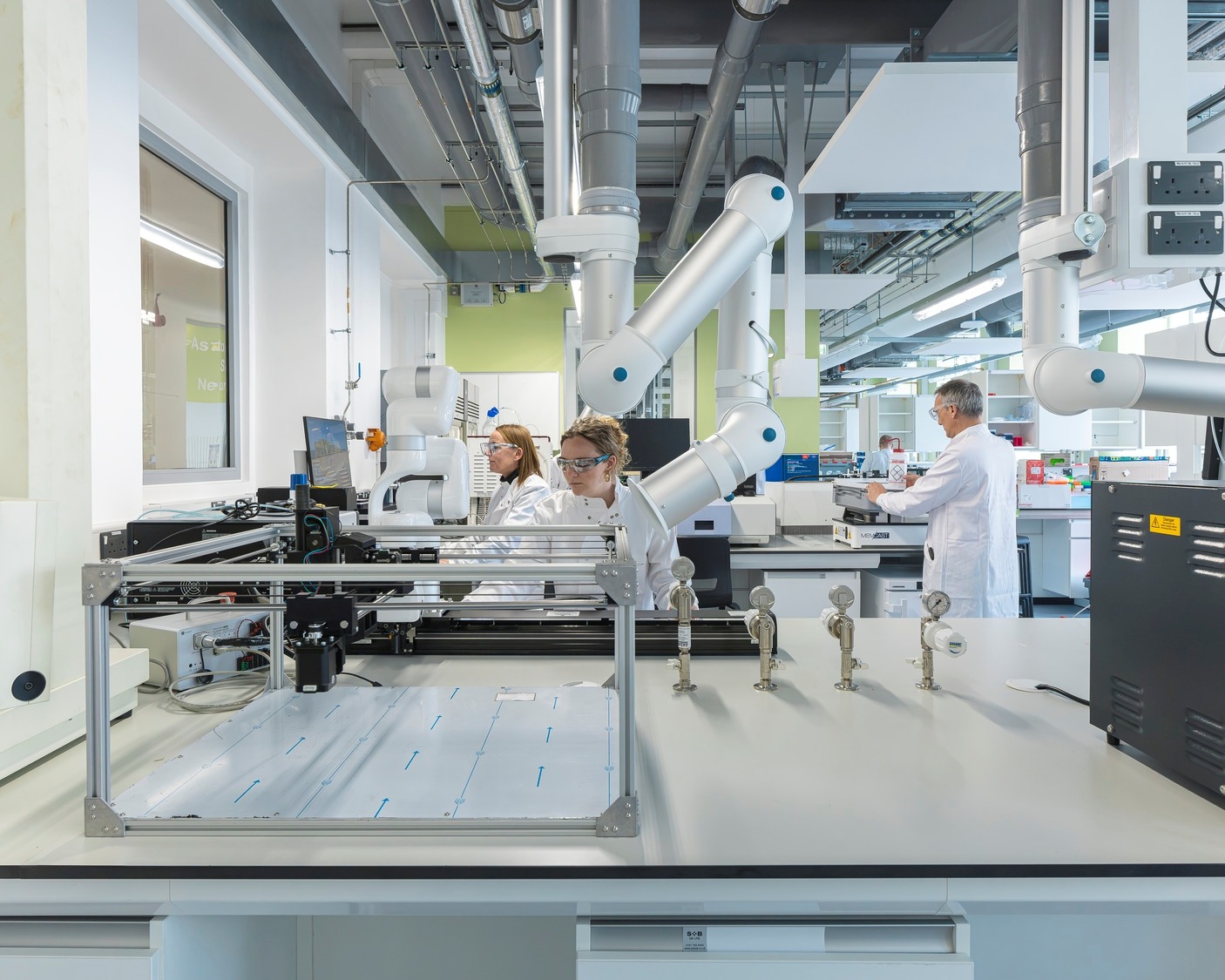
The Aston Institute for Membrane Excellence, Aston University
Broadway Malyan
Client: Aston University
Backed by a £10 million Research England grant – the largest Aston University has ever received – AIME brings together expertise in membrane biology, polymer chemistry and engineering. Its researchers are developing new membranes with applications ranging from drug discovery to water purification.
Yet this interdisciplinary ambition was previously constrained by fragmented facilities including small laboratories and equipment rooms dispersed throughout Aston University’s seven-storey, 1930s Main Building.
Rather than create a new facility elsewhere, Broadway Malyan reimagined approximately 400 sqm of the existing building, consolidating researchers, processes and more than £2 million of specialist equipment onto a single floor. The resulting laboratory substantially increases the performance of the available space while giving renewed purpose to ageing university fabric.
The project’s defining challenge was to bring chemistry and microbiology together within one open-plan Containment Level 2 environment. The disciplines have different cleanliness requirements and contamination risks and were widely considered incompatible within a shared atmospheric space.
Broadway Malyan resolved this through precise spatial and engineering integration. Chemistry and microbiology occupy distinct “neighbourhoods” at opposite ends of the laboratory, without a physical partition between them. Chemistry processes are contained within fume cupboards, while shared instrument areas and unobstructed sightlines connect the disciplines. Large fridges and freezers are concentrated within a secondary utility zone, maintaining openness and minimising movement between workstations, benches and specialist equipment. An adjacent cell tissue culture laboratory provides a more controlled environment, connected through a carefully choreographed transition sequence.
The spatial transformation was matched by a cultural one with researchers accustomed to working in isolated room invited to shape the new environment through hands-on co-design workshops. Using a large-scale plan and paper representations of every item of equipment, they tested adjacencies, workflows and opportunities for sharing. The resulting plan informed technical coordination and continues to be used for researcher inductions, demonstrating genuine ownership of the design.
Large internal windows place scientific activity on view from the adjoining corridor, allowing students, visitors and industry partners to observe research without entering or interrupting the controlled environment. Height-adjustable workstations and walk-in fume cupboards, step-free access and integrated safety sequences ensure that inclusion and responsible behaviour are embedded within everyday use.
Achieving BREEAM Silver, the project combines the embodied-carbon benefits of refurbishment with variable-extraction fume cupboards that reduce energy consumption when not fully open and ethically sourced laboratory furniture.
AIME proves that reuse need not constrain scientific ambition and that through forensic planning, co-design and technical ingenuity, Broadway Malyan has transformed a limited area of an existing building into a world-first research environment – replacing seven storeys of separation with one shared space for scientific innovation.