Bigger Picture. Connected Worlds of Bruges 900–1550
Tinker imagineers
Client: Musea Brugge (BRUSK)
Tinker was responsible for concept design, exhibition design and art direction, working closely with Musea Brugge, historian Peter Frankopan, and an international team of experts. The exhibition brings together around 250 artworks and heritage objects, from paintings, manuscripts and tapestries to maps, archaeological finds and fragile international loans.
Across 1,600 m², the central design challenge was to create intimacy, rhythm and orientation within BRUSK’s monumental 13.5 metre high gallery. The design also had to meet demanding security, climate, lighting and conservation requirements, while allowing objects of different scales and materials to retain their individual presence.
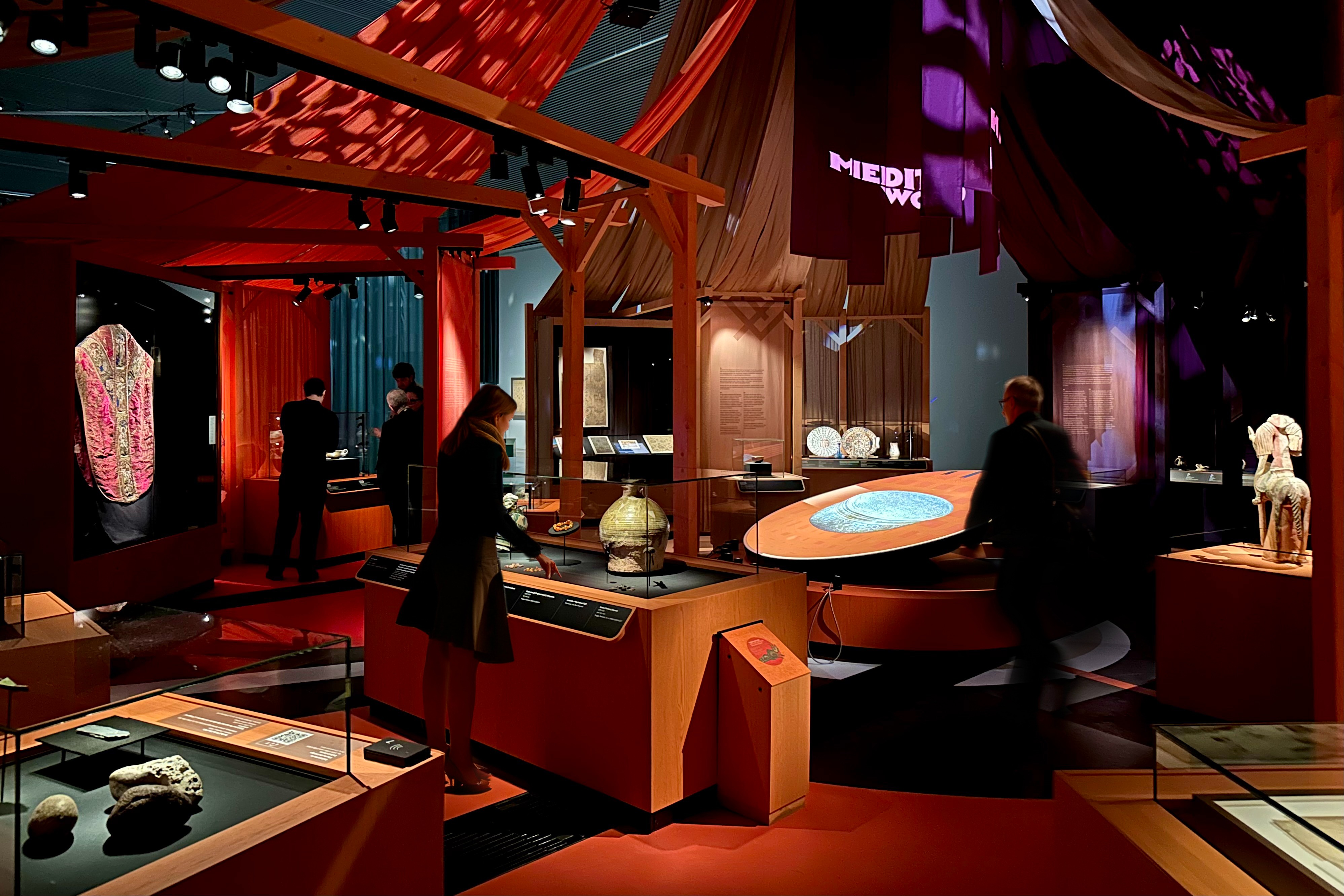
Tinker translated the curatorial idea of interconnectedness into a spatial language. Five thematic chapters explore the North Sea, the Mediterranean, the Near East, the Christian World and distant expeditions. Each is conceived not only as a distinct world, but as a worldview: a semi open, semi enclosed way of looking at the world that remains fluid, partial and continually changing. Layered walls, framed openings and carefully aligned sightlines allow visitors to look from one region and period into another. The chapters can be explored in any order, creating a journey shaped by curiosity rather than fixed chronology. Bruges returns throughout as a recognisable point of connection.
A rich yet restrained material palette gives each chapter its own atmosphere without resorting to historical imitation. Deep mineral colours, visible wood textures, natural timber frames and precisely detailed dark display elements create a contemporary setting for the historic collection. Large maps and graphic enlargements shift the visitor’s perspective between object, city and world. Integrated conservation cases and focused lighting create luminous islands within the darker scenography.
The installation was developed with specialist fabricator Bruns. Around 90% of the museum’s existing showcases were reused. Tinker analysed the dimensions and conservation needs of each object to integrate them into the available cases, combining a strong spatial identity with practical and sustainable reuse. A dedicated children’s route adds a playful sensory layer. Simple assignments invite younger visitors to look, touch, smell and act, while a stamp collecting journey encourages families to explore the chapters together.
The result makes a complex global history clear, tangible and emotionally engaging. Rather than presenting the Middle Ages as static or insular, Bigger Picture reveals history as an active web of movement, exchange and cultural influence. It gives each object space to speak individually while reconnecting it to the larger world beyond Bruges.