
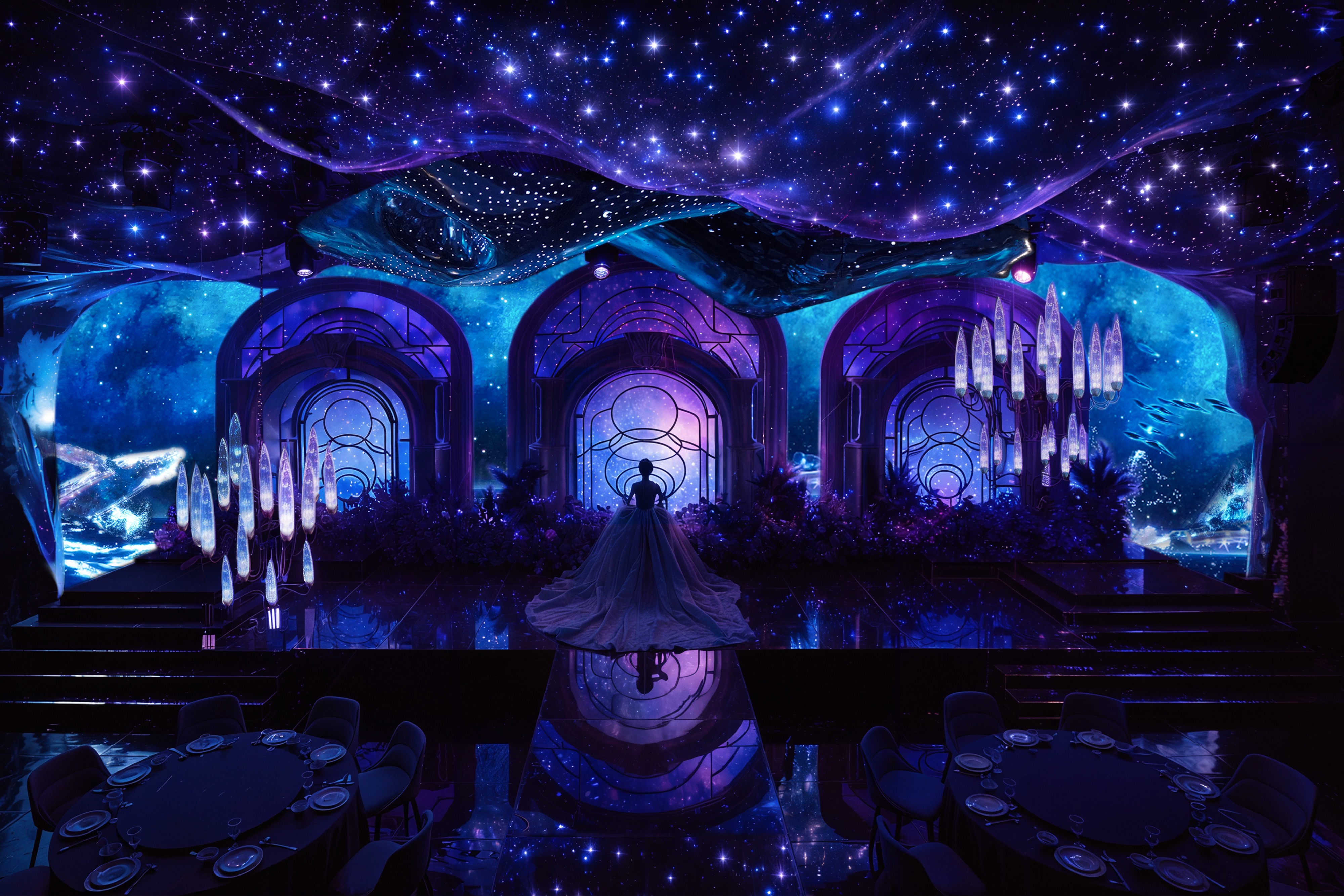
Caribbean Sea Wedding Hall
Chongqing Shensheng Decoration Engineering Design Co
Client: Fantora wedding center
The experience begins in a dark prelude gallery, where pointed metallic arches, patterned screens, luminous openings and mirrored surfaces establish a threshold between architecture and an imagined underwater world. From this compressed and mysterious approach, guests enter the main hall, which opens into a panoramic landscape of ocean, sky and light. This progression gives the project a clear dramatic structure: anticipation, revelation, movement and climax.
The bride’s entrance is treated as the central performance. Ambient light gradually recedes, a concealed portal is revealed in blue-violet backlight, and the bride first appears as a silhouette. As she moves toward the ceremony centre, light, imagery, sound and reflection follow and intensify. At the climax, the entire hall transforms in synchronization. The bride is therefore not simply entering a decorated room; her movement activates the environment and completes the narrative.
Six integrated systems operate as one sensory instrument. Parametric LED surfaces create a dynamic oceanic boundary. Perforated stainless steel filters and diffuses luminous imagery, while reflective surfaces extend media content and dissolve spatial limits. Intelligent lighting shapes focus, rhythm and depth. Spatial audio builds directional perception and emotional momentum. A central control system synchronizes lighting, sound and digital media with each ceremonial cue. Technology is embedded within the architecture and perceived as atmosphere rather than equipment.
Because the media, lighting and audio are programmable, the hall can move from silence and low illumination to colour, motion and full sensory intensity without changing its architectural framework. Multiple scenes support different moments of the event while retaining one coherent identity. This adaptability allows the space to function as a repeatable performance platform rather than a static decorative setting.
Visitor experience is supported by three independent circulation systems. Guests move from the prelude gallery into the immersive hall; the bride follows a dedicated route structured around concealment and reveal; and service operations remain within backstage areas. This separation improves clarity, privacy and efficiency while preventing operational movement from interrupting the performance. The narrative sequence also gives visitors an intuitive sense of arrival, transition and destination.
The project reinterprets the wedding as a shared cultural event. By avoiding literal regional symbols and translating Caribbean nature through contemporary spatial language, it creates an inclusive emotional setting rather than a themed replica. Bringing up to 500 people into one synchronized sensory experience strengthens the wedding’s role as a collective ritual. The result is a new model of entertainment space in which architecture, ceremony and performance become inseparable.