
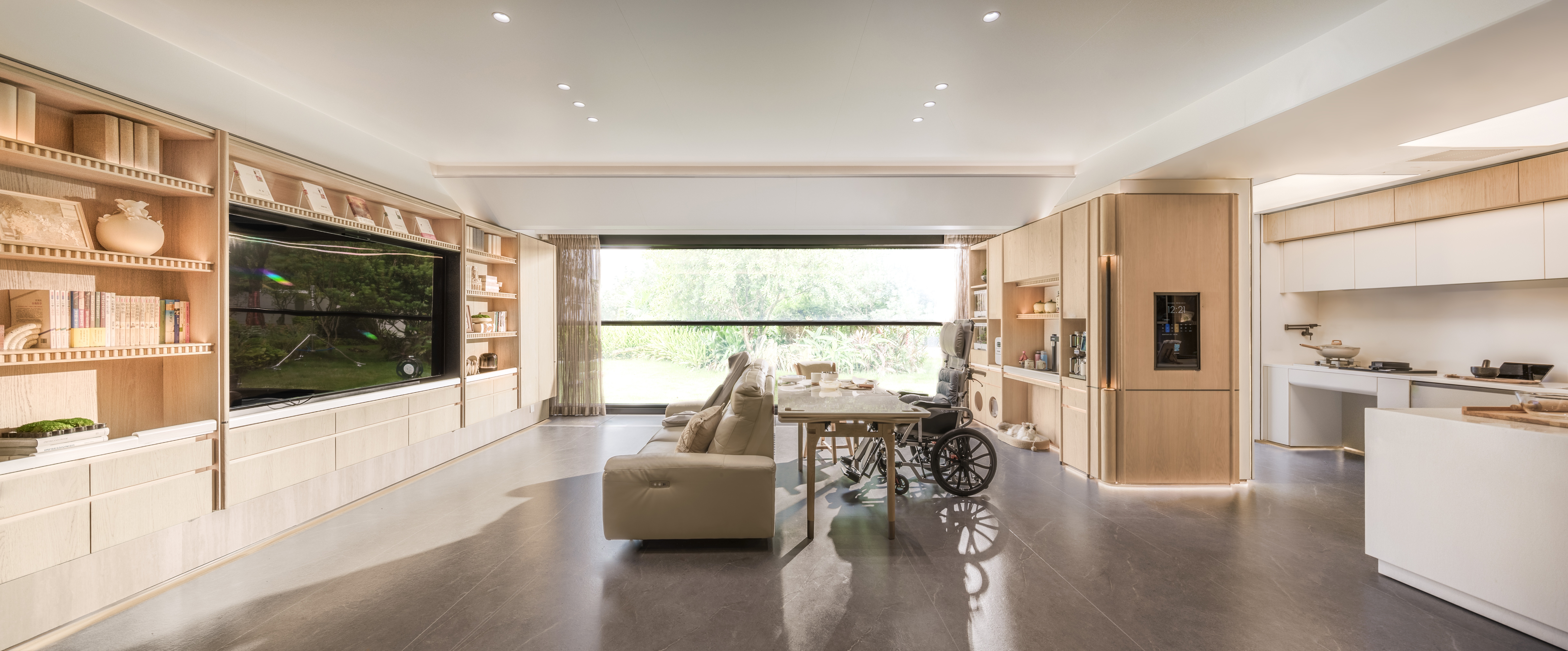
Pearl River Enterprises Group Smart House No.3 Lab
PEARL RIVER ENTERPRISES TECHNOLOGY
Client: PEARL RIVER ENTERPRISES GROUP
silver-hair economy, the publicly-accessible Smart-Living Park Lab 3 has been purpose-built. Following six months of targeted research, the design team conducted quantitative analysis on more than 3,000 samples alongside focused studies of 100 case units, turning the vision of home-based elderly care into tangible reality.
Traditional elderly-care dwellings tend to retain prominent design cues of ageing, such as exposed handrails and slip-resistant flooring. Guided by the core design philosophy of "active perception and independent self-support", the design team artfully conceals both horizontal and vertical handrails throughout the space. It integrates tactile training materials, mood-soothing aromatherapy, therapeutic wall panels and multi-layer shadow-free lighting, paired with a smart home system that drives embodied robots. Even when elderly users suffer declining eyesight, physical mobility or memory, they can experience a comfortable and unburdened care environment without perceiving assistive interventions.
Spatial functionality has also been innovated. Enabled by horizontally displaceable cabinetry and central-axis rotation mechanisms, a single space can accommodate diverse functions including tea-room leisure, rehabilitation therapy and short-term accommodation. It adapts to varied living scenarios: solitary elderly residence, elderly-couple households, multi-generational occupancy and settings with live-in caregivers. Occupants can trigger all these scene transitions merely through voice commands. Furthermore, integrated smart systems incorporate millimeter-wave radar fall detection, full-scope risk alert and voice-enabled central control. Responding to the occupant's physical capacity, behavioural patterns and indoor environmental shifts, the space autonomously adjusts lighting brightness, colour temperature and spatial modes without manual input, delivering round-the-clock imperceptible proactive protection.
In terms of detailing, the design team enables the residence to "grow alongside" its occupants as they age. Sufficient clearance is reserved within the living room to facilitate upgrades from standard two-seater sofas to rise-assist seating, and to accommodate specialised wheelchairs for users with advanced mobility impairment in later life. The dining area is fitted with a meal-preparation cabinet equipped with medication-reminder functions, while the master bedroom features an electrically separable bed configurable for combined or split use. For elderly occupants requiring care-dependent support, the large-radius stone-finished window sill supports sit-bath routines.
China upholds the millennia-old social ideal of "security in old age", which embodies the principle that senior citizens deserve essential daily care and material support from both families and society. This national-level age-friendly living demonstration lab, meticulously developed by Zhujiang Industrial Group, originates from the aspiration to translate conceptual ideas into widely replicable practical models through sustainable, human-centred systematic residential solutions, so as to fulfil a benevolent vision benefiting society at large.